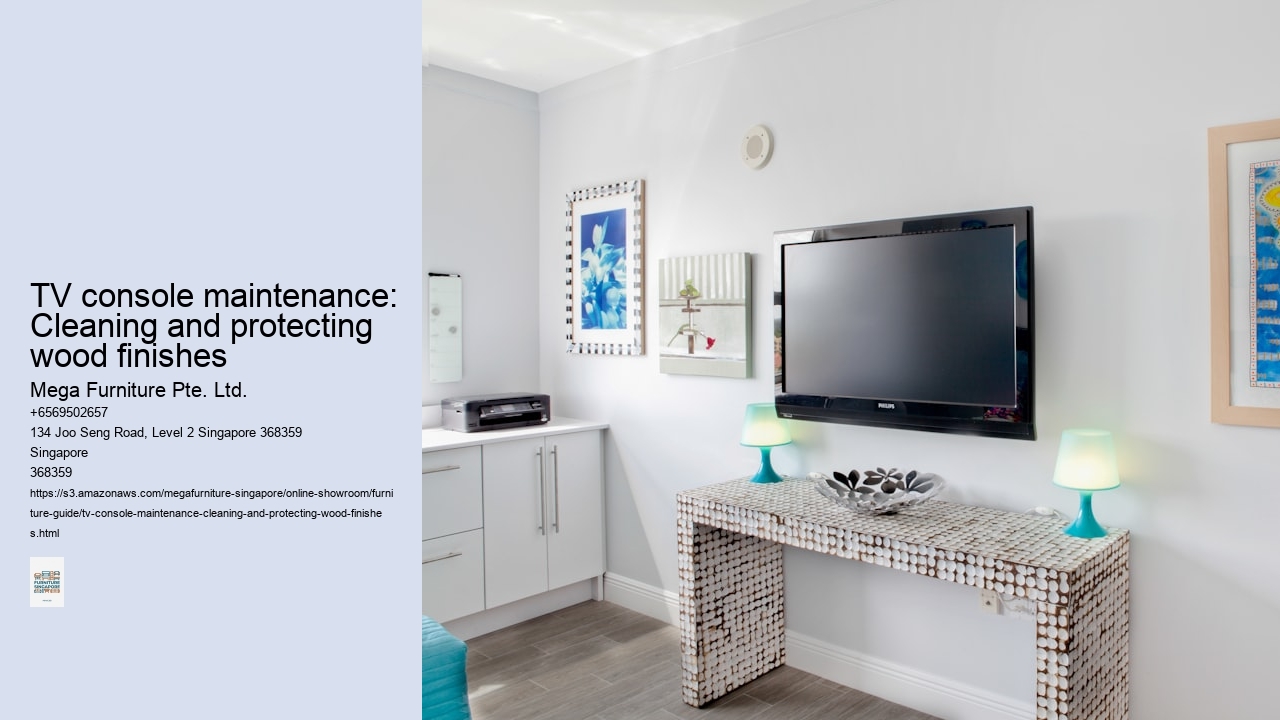
The wood finish on that sleek new console will show its first crack not from a stray controller, but from the air itself. In Singapore’s 80% humidity, veneers and lacquers that aren’t explicitly moisture-resistant will cloud and bubble within a year, leaving a permanent watermark where you once placed a glass. Prioritise sealed, factory-applied finishes over raw, oiled woods; a rubberwood frame with a high-pressure laminate wrap often outlasts a more expensive but porous teak.
Material choice gets more practical with kids and pets in a 4-room BTO. Laminate surfaces, while sometimes feeling less premium, are the clear choice for resisting crayon, paw marks, and the inevitable juice-box spill. Solid wood might develop a patina from such incidents, but that’s just a polite term for a permanent stain in many homes — and cat claws will shred an unprotected oak veneer in weeks.
Then there’s the geometry of the thing. Depth is non-negotiable: a unit must swallow an AV receiver, which typically needs 40cm of clearance for cables and ventilation, plus the bulk of a PS5. Yet it can’t protrude into the walkway of a narrow living room, where every centimetre towards the dining table counts. The sweet spot is a 45cm to 50cm depth, offering that crucial internal cavity while keeping the overall footprint slim.
Don’t forget what goes on top. A 75-inch television is a significant weight, often exceeding 40kg without its stand, and a console’s load rating must account for it plus any decorative items. Particleboard constructions with thin centre supports will sag over time; look for solid internal frames or reinforced central legs. It’s a boring spec sheet item, but it’s the difference between a stable centrepiece and a costly, wobbling hazard.
Ultimately, the right console balances these invisible defences — against climate, chaos, and sheer weight — with the clean lines you wanted in the first place. You can browse options built for these local demands at Megafurniture’s collection.
A buyer might assume any wood is good wood, but that's a costly mistake for a TV console. Solid timber frames, typically rubberwood or oak, won't warp under the weight of a 75-inch screen and won't crumble when you inevitably knock into them while vacuuming. They're heavier, sure, which makes assembly in your fourth-floor walk-up flat a chore, but that heft translates to stability that lasts decades. Particle board cores, especially common in budget-friendly wall-mounted units, simply can't match that inherent strength over time. You're paying for permanence, not just a surface that looks like wood from three metres away.
Singapore's humidity is relentless, and it finds its way into every unsealed surface. Particle board or MDF used in shelving or side panels must have their edges completely laminated or banded; any raw, exposed edge is a sponge waiting to swell. That swelling warps drawer fronts, causes doors to stick, and creates a perpetually damp environment perfect for mould. It's a slow-motion failure you'll notice one humid August morning when the console door in your Tampines flat simply won't close properly. Proper sealing is a non-negotiable barrier against our climate.
Full-extension mechanisms are the quiet heroes of organised storage, letting you access that last gaming controller at the very back without a frantic dig. Cheap, partial-extension slides feel gritty after a few months and leave a third of your drawer space functionally useless. For a media console holding consoles, routers, and cable boxes, smooth operation is everything—you'll be opening these drawers weekly, if not daily. Ball-bearing, soft-close runners might add $50 to the price, but they prevent the sag and eventual collapse that turns your storage into a jammed-shut junk drawer.
Look underneath or inside the cabinet; the joinery tells the real story. Dovetail or mortise-and-tenon joints in drawers are a clear signal of furniture built to handle assembly, disassembly, and years of loaded use. Stapled or glued butt joints, however, are a major red flag—they rely on adhesive alone and often fail under the shifting loads of a typical family living room. That failure might mean a drawer bottom dropping out under a pile of Blu-rays or the entire side panel pulling away from the frame. It's craftsmanship you can't see on the showroom floor, but you'll definitely feel it at home.
Few HDB or condo floors are perfectly level, and a wobbly TV console is both a nuisance and a safety hazard. Adjustable feet, often concealed behind a toe-kick, let you stabilise the unit on uneven terrazzo or timber flooring without resorting to shims or folded paper. This isn't just about stopping a rattle; it ensures doors and drawers align correctly and the weight distribution is even across the entire frame. Skipping this feature means your expensive console is permanently at the mercy of your building's slab—and that's a losing battle.
Buying a 240cm console for a 3-metre wall seems like a perfect fit, but it leaves no breathing room for floor lamps or side tables — the unit becomes a monolithic block against the living room wall. Oversizing is a common reaction to the blank wall in a new BTO flat, but it makes the space feel furnished rather than lived-in. The better calculation is to subtract 60cm from your wall length; that gap allows for a plant, a stack of books, or simply visual relief.
Neglecting cable management grommets turns a sleek console into a tangled mess behind it. You’ll drill a hole for the TV power cord, then realise the router, soundbar, and gaming console each need their own exit — and that’s before the internet technician arrives with yet another cable. Built-in grommets, or planning for them, keep the back panel clean and accessible; in many landed homes with longer cable runs from the router, this becomes essential.
Glossy finishes, especially high-gloss lacquer or acrylic, show every speck of dust in Singapore’s humid air. They look striking in a showroom at Megafurniture’s Joo Seng outlet, but in a Tampines HDB with windows open daily, they require constant wiping. A satin or matte finish, or even a textured wood grain, hides dust buildup between weekly cleans and better handles the light from a south-facing window.
Forgetting to measure elevator and staircase clearance is a delivery-day disaster. A 240cm unit often comes in one piece; if it doesn’t fit diagonally in the condo elevator or can’t navigate the tight turn in a pre-war shophouse staircase, you’re stuck with a crate in the loading bay. Always confirm the packaged dimensions, not just the assembled ones — that extra 15cm of padding can be the difference between installation and a costly return.
Finally, choosing a console without proportional storage leads to clutter on top. A 75-inch TV demands a console around 180cm to 220cm long; if that unit only has two drawers, all the remotes, game controllers, and charging cables end up in a basket on the surface. Look for designs that allocate at least one-third of the length to concealed storage, with the remainder for display or open shelves.
A console's laminate finish can look flawless online — it's the drawer glides that betray a cheap unit. You'll hear that click-click-click every time you reach for a remote or a game controller, a sound that wears on you long before the finish does. At Megafurniture's Joo Seng showroom, that hands-on assessment is unavoidable; you can run a finger along the edge of a door panel to feel for any chip or warp, and test the smoothness of every drawer glide yourself. It's a simple check, but one that online images can't replicate, and it often separates a console that lasts five years from one that needs replacing in two. Scale is another critical factor, especially when you're considering a unit around 2.4 metres long. In a typical 4-room BTO living room, a console that size can dominate the wall — or look perfectly proportional. The showroom's mock-ups of HDB living spaces let you visualise that real-world fit before you commit. You can judge whether the console's height leaves enough clearance for a soundbar, or if its depth crowds the walkway to the balcony. That visual confirmation is worth the trip; buying a console that's ten centimetres too long for your wall is a mistake you'll see every day. Stability under load is the final, practical test. A console might look solid, but you need to know how it behaves when fully extended and loaded with a media player, books, or decorative objects. In the showroom, you can apply weight — a firm push — to the open drawers and shelves to check for any wobble or sag. This isn't about being rough with the furniture; it's about simulating the conditions of a lived-in home, where a console isn't just a display piece but functional storage that gets used daily. For design-focused shoppers, the finish and colour in a controlled showroom light also matter more than you'd think. A walnut laminate might appear warm and rich on your phone screen, but under the fluorescent lights of your own flat, it could look flat and synthetic. Seeing it in person, alongside the other materials and textures in the mock-up rooms, helps you coordinate it with your existing sofa or flooring. It turns an abstract choice into a concrete one, which is the whole point of visiting — you're not just buying a piece, you're fitting it into a specific, limited space in your home. Browse the options at
Megafurniture's collectionto see what might work, then go and give the drawers a push.
A two-man delivery team stuck in a BTO lift lobby with a 240cm TV console is a common, expensive headache. Confirm your building’s lift dimensions—many newer BTOs have lifts around 150cm deep, but older resale blocks might only accommodate 120cm. Measure your own lift’s diagonal, not just its width; that extra few centimetres is often what lets you manoeuvre a long, flat-packed box inside. If the console won’t fit, you’re looking at stairwell delivery, which typically adds $80 to $150 and a serious risk of scuffing and corner damage before the unit even reaches your door.
Professional assembly isn’t a luxury for chipboard or laminate consoles—it’s damage prevention. A rushed DIY job can easily over-tighten cam locks, strip particleboard threads, or misalign panels, leaving you with wobble or exposed, chip-prone edges. Most decent retailers include it; if they don’t, budget around $60 to $120 for a proper installer. They’ll have the tools and technique to handle the brittle MDF backs and fragile laminate veneers that define most consoles in the $400 to $1,200 range.
Singapore’s humidity makes a comprehensive warranty non-negotiable. Look for a clear 3–5 year coverage that explicitly lists laminate peeling, edge banding separation, and hinge mechanism failure. The crucial clause is coverage for ‘humidity-induced warping or swelling’; without it, a retailer can blame the climate for any bowed shelves or doors that won’t close. A console facing a sunlit window or positioned near an air-con unit faces extreme microclimates, and the warranty should acknowledge that.
For peace of mind, keep the warranty document digitally and note the claim procedure. Some require photos sent via WhatsApp, others a service ticket—know the drill before you need it. A robust warranty is the best indicator that a retailer trusts their own joinery and materials to last in our local conditions. You can review the specifications and service terms for various models in Megafurniture’s collection to compare what’s on offer.
The most telling questions from homeowners often skip the aesthetics entirely — they're about load-bearing walls and bleaching afternoon sun. You've bought the 85-inch set, and now the real work begins.
Can a console hold an 85kg TV? It's less about the cabinet and more about its internal frame. Look for solid timber or engineered wood constructions rated for at least 120kg dynamic load; a 240cm solid rubberwood console, for instance, typically supports that weight if the TV's centre of gravity is over the cabinet's centre stile. Wall-mounted or floating consoles need specific brackets anchored into studs, not just the panel backing.
Best finish for west-facing sun exposure? A satin or matte laminate in a light grey or warm white finish resists yellowing better than a high-gloss white, which can turn creamy under constant UV. For timber, a factory-applied UV-inhibiting lacquer over teak or oak is your best defence against the relentless sun in a Tampines or Bedok flat — untreated wood will warp and fade within a season.
How to clean white laminate without yellowing? Avoid anything with bleach or ammonia. A weekly wipe with a microfibre cloth dampened with a 50/50 mix of white vinegar and water lifts grime without damaging the protective melamine layer; follow with a dry cloth to prevent moisture seepage into joins. For tougher marks, a paste of baking soda and water works, but test it on a rear panel first.
Wall-mounting on HDB hollow brick — possible? It is, but you'll need specialised hollow-wall anchors, like toggle bolts or metal spring toggles, which spread the load behind the plaster. The critical step is using a stud finder to locate the vertical concrete columns, which are spaced about 60cm apart in a typical BTO living room wall; secure at least one side of your bracket into that concrete. For complete peace of mind, a floor-standing console eliminates the guesswork entirely, and you can browse the options for models with integrated cable management to handle all those devices.
The moment you’re ready to tap "add to cart" is the moment you should walk away from your laptop. Pull out the tape measure and verify the console’s length against your actual TV width — that 180cm unit might look balanced online, but it’ll feel dwarfed by a 65-inch panel in your 4-room BTO living room. Then check the depth: you’ll need at least 45cm to comfortably house a PlayStation, a media streamer, and their tangled cables, but anything over 55cm starts encroaching on precious floor space in a compact layout. It’s a simple cross-reference that prevents the most common buyer regret.
Storage capacity often clashes with visual lightness, especially in flats under 90 sqm. A console packed with drawers and cabinets solves practical clutter, but its bulk can anchor the room too heavily. In many homes, the better compromise is a floating design with a mix of concealed and open shelving — you hide the essentials behind a door, then use the open bays for a few books or a plant, which keeps the wall feeling airy. That approach works well for condos with feature walls, where the console is meant to be noticed but not overwhelm.
Material choice becomes critical if you’re integrating the console into a designed media wall. Existing teak or walnut flooring sets a tonal baseline; a console in a complementary oak or ash finish will pull the look together, while a stark black laminate might create a jarring contrast. For a more cohesive statement, some buyers select a sintered stone top or a textured veneer that echoes the grain and colour temperature of the floor — it’s a detail that feels intentional.
Finally, consider how you’ll actually use the storage day-to-day. A family with gaming consoles and board games needs deep, accessible compartments, while a minimalist condo owner might prioritise sleek, shallow drawers for remote controls and chargers. There’s no single right answer, but matching the internal layout to your household’s real clutter stops the unit from becoming a decorative obstacle. You can browse a range of solutions that address these specific needs at Megafurniture’s collection.
Measure twice, buy once — that old adage holds, but here it’s about measuring your TV, your devices, and your room’s aesthetic balance all at once.
The door swing in a 4-room BTO is the great, unmentioned dictator of furniture placement. You might measure for a perfect 180-centimetre console against that 3.8-metre living room wall, only to find the main door or bedroom door arcs right into its corner. That leaves a frustrating sliver of dead space, or worse, a permanent dent in the console's finish. It's a classic BTO oversight - you're forced to shift the entire unit off-centre from the TV, or choose a shorter design that leaves awkward gaps.
Condo feature walls offer more flexibility, but they introduce their own constraints. Many have pre-existing built-in niches or wiring conduits that demand precise, millimetre-perfect measurements. A floor-standing unit that's too tall can block a crucial power point or air-conditioning vent hidden at skirting level. A TV console anchors the wall opposite the sofa in the same way a tall bookshelf anchors a corner — long horizontal piece, mix of open and closed storage, defines the visual weight of one whole side of the room. Megafurniture's TV Console range covers floating wall-mounted designs, low-profile freestanding consoles, and modular feature-wall configurations. Most pieces sit at 40-50cm height, sized for screens up to 75 inches.. The solution here is often a custom or modular floating console; it clears the skirting, aligns with the niche, and maintains that clean, built-in look without permanent installation.
In resale flats, you're negotiating with history. Previous owners might have installed floor-to-ceiling built-in cabinets along one wall, leaving only a specific, often narrow, alcove for the TV. Sideboard . A bulky, deep console won't just overwhelm the space - it'll block cabinet doors from opening fully. For these compact 12 sqm living rooms, a shallow, wall-mounted design is almost non-negotiable. It provides the necessary surface without stealing precious walking space, keeping the centre of the room clear for daily life.
That's why floating consoles have become a default for many Singaporean homes. They create a visual lightness that floor-standing units can't match in narrow layouts, and they simplify cleaning - no more awkward manoeuvring around legs with a mop. For a curated selection of wall-mounted and space-saving designs, you can browse Megafurniture's TV console collection. Just remember to account for your specific wall type; mounting on a hollow HDB partition wall requires different hardware than a solid concrete condo feature wall.
Ultimately, the console's dimensions are a direct negotiation with your floorplan's idiosyncrasies. A 240-centimetre media unit might look stunning in a showroom, but in a typical HDB living room, it could leave you sidling past it like it's a piece of architectural furniture. The better approach is to work backwards: map out your clear walkways first, then see what console length genuinely fits.
The door swing in a 4-room BTO is the great, unmentioned dictator of furniture placement. You might measure for a perfect 180-centimetre console against that 3.8-metre living room wall, only to find the main door or bedroom door arcs right into its corner. That leaves a frustrating sliver of dead space, or worse, a permanent dent in the console's finish. It's a classic BTO oversight — you're forced to shift the entire unit off-centre from the TV, or choose a shorter design that leaves awkward gaps.
Condo feature walls offer more flexibility, but they introduce their own constraints. Many have pre-existing built-in niches or wiring conduits that demand precise, millimetre-perfect measurements. A floor-standing unit that's too tall can block a crucial power point or air-conditioning vent hidden at skirting level. The solution here is often a custom or modular floating console; it clears the skirting, aligns with the niche, and maintains that clean, built-in look without permanent installation.
In resale flats, you're negotiating with history. Previous owners might have installed floor-to-ceiling built-in cabinets along one wall, leaving only a specific, often narrow, alcove for the TV. A bulky, deep console won't just overwhelm the space — it'll block cabinet doors from opening fully. For these compact 12 sqm living rooms, a shallow, wall-mounted design is almost non-negotiable. It provides the necessary surface without stealing precious walking space, keeping the centre of the room clear for daily life.
That's why floating consoles have become a default for many Singaporean homes. They create a visual lightness that floor-standing units can't match in narrow layouts, and they simplify cleaning — no more awkward manoeuvring around legs with a mop. For a curated selection of wall-mounted and space-saving designs, you can browse Megafurniture's TV console collection. Just remember to account for your specific wall type; mounting on a hollow HDB partition wall requires different hardware than a solid concrete condo feature wall.
Ultimately, the console's dimensions are a direct negotiation with your floorplan's idiosyncrasies. A 240-centimetre media unit might look stunning in a showroom, but in a typical HDB living room, it could leave you sidling past it like it's a piece of architectural furniture. The better approach is to work backwards: map out your clear walkways first, then see what console length genuinely fits.